

Let’s be honest - getting an AI agent up and running in ServiceNow is the easy part. Making one that actually does something useful? That’s where engineering matters.
AI Agents aren’t meant to be fancy chatbots. When designed well, they’re digital workers that can understand intent, retrieve the right data, and take action across the platform. When designed poorly, they hesitate, hallucinate, or flood users with “I’m not sure” responses. The difference comes down to a few key principles.
1. Start With a Clear Job Description
Every effective AI Agent has a narrowly defined purpose. Instead of “help users with tickets,” think:
- Look up ticket status across multiple tables
- Route incidents based on short descriptions
- Fulfill common requests without human intervention
If you wouldn’t give a task to a new hire without instructions, don’t give it to an AI Agent.
2. Tools Matter More Than Prompts
Let’s be a little opinionated here: prompts don’t solve problems - tools do.
You can write the cleanest, most elegant instructions in the world, but without the right tools, your AI Agent is just politely guessing. A production-ready agent needs access to:
- Record operations (lookups, updates, creation)
- Flows or actions it can safely trigger
- Controls that define when not to act
Think of prompts as guidance and tools as capability. One without the other is where most AI Agent implementations quietly fail.
3. A Real Micro Example: Ticket Lookup Done Right
Here’s where this gets real.
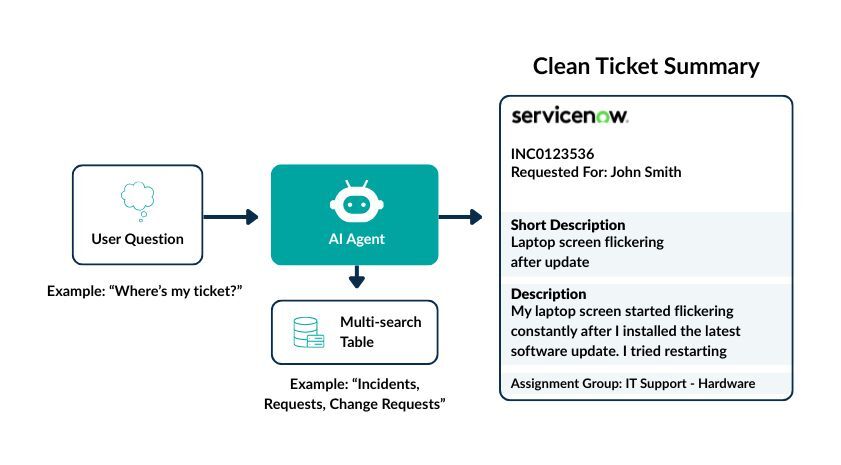
Imagine a user types: “What’s going on with my laptop ticket?”
A well-designed Ticket Lookup AI Agent will:
- Identify the user by name, email, or username
- Search across incidents, requests, requested items, etc., tables
- Return the most relevant active records with status and next steps
- Ask a follow-up only if needed
No guessing. No dumping 20 results. No "please contact support." Just clarity.
What makes this work:
- A focused instruction: find up to 5 relevant tickets
- A lookup tool scoped to approved tables
- Logic that prefers active over closed work
- Safeguards to avoid exposing unrelated data
This is the difference between an AI Agent that feels helpful - and one that feels random.
4. Design for Confidence and Restraint
The best AI Agents know when to proceed - and when to stop. Build in fallback behavior for edge cases, incomplete data, or low confidence scenarios. Sometimes the smartest action is handing things off to a human.
4. Treat Data Quality as a Feature
AI Agents amplify whatever data you give them. Clean categories, consistent descriptions, and reliable ownership models directly impact agent success. Garbage in still means garbage out - just faster.
5. The Payoff
When designed intentionally, AI Agents reduce noise, speed up resolution, and quietly improve user experience without flashy dashboards or massive change efforts. They don’t replace teams - they remove friction.
ServiceNow AI Agents aren’t about doing more. They’re about doing the right things automatically.
Interested in learning more? Drop us a note at chat@rapdev.io.



.png)