
We showed up 26 strong with a demo lineup built entirely around agentic AI. From the first conversation Tuesday morning to the final fist bumps heading to the airport Friday, the energy on the floor was different this year. It wasn't "are you doing AI?" - it was "how fast can we actually move with it?"
That shift was impossible to miss, and RapDev came ready.
What We Showcased
This year, our focus was sharp: AI doing real work, right now, across the modules you're already running.
Our engineers ran live Now Assist demos across six practice areas - ITSM, ITOM, SecOps, ITAM (HAM + SAM), IRM, and SPM - showing what agentic AI looks like when it's actually embedded in your workflows. We're talking things like generating post-incident reviews from a resolved major incident, triaging and categorizing ITSM tickets with full service/CI context, assessing vulnerability exposure, auto-generating regulatory action plans, and creating agile stories from a feature brief. Not slide decks. Live instances, real outputs.
We also ran a live AI Control Tower demo featuring real-world RapDev agents - showing attendees what governed, discoverable AI actually looks like in practice, not just in theory.
The through-line across every demo was the same question customers kept asking at the booth: "Can AI actually help me here, or is it just a chatbot on top of my existing mess?" The answer we kept showing was yes - and here's exactly how.
The Conversation on the Floor
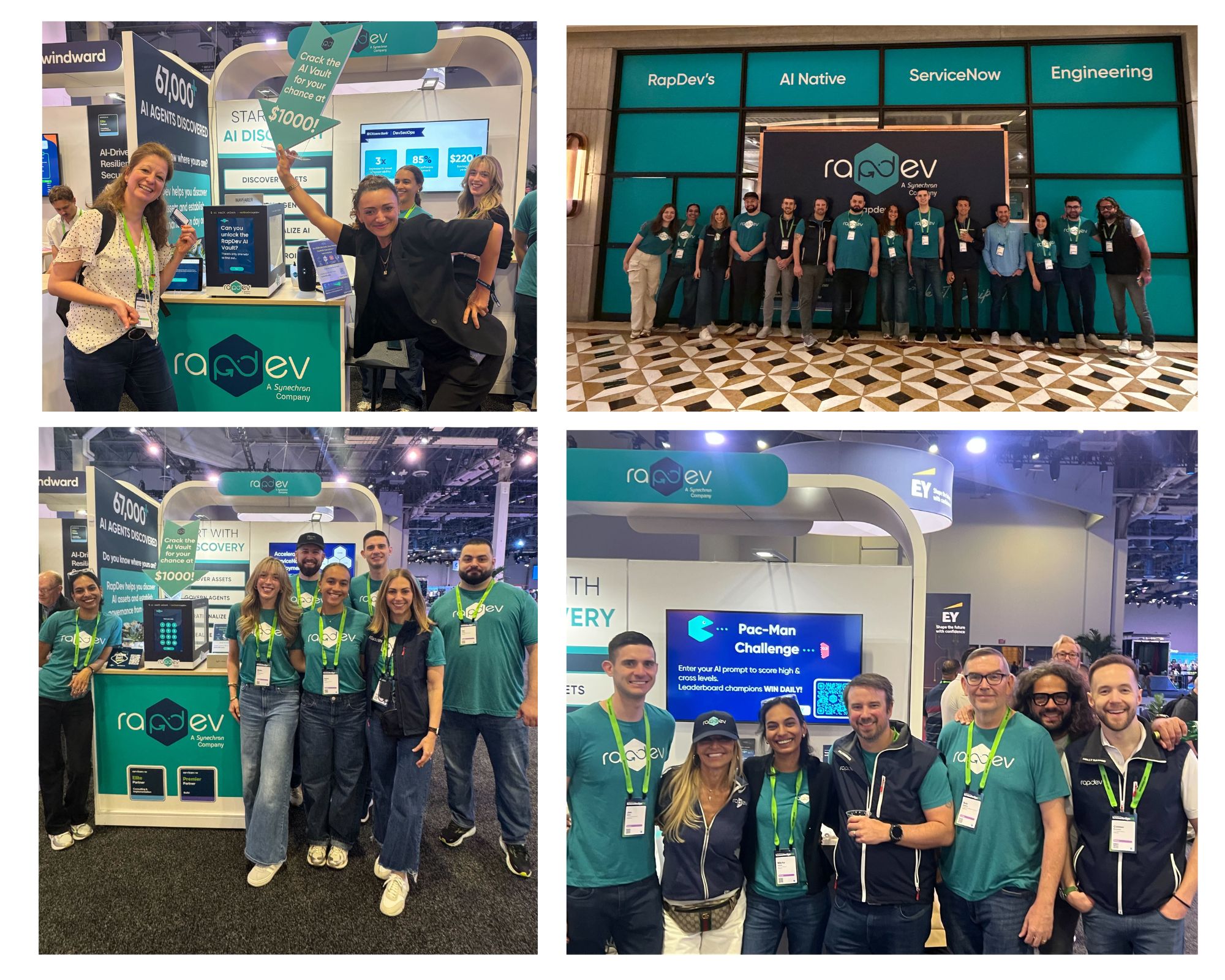
Walk the expo floor at K26 and you'd hear some version of the same conversation at nearly every booth. But at ours, it kept coming back to two things: how do I accelerate day-to-day operations with AI, and how do I finally get my CMDB and platform data healthy enough to make any of this work?
Those two questions are deeply connected. AI on ServiceNow is only as good as the data underneath it - and for a lot of organizations, CMDB health is the unlock they're still chasing. We had a lot of honest conversations about that gap, and about what it actually takes to close it. That's the kind of dialogue we live for.
The Platform, Built for This Moment
ServiceNow came out swinging at K26. The headline was the shift from assistive to agentic - AI that doesn't just suggest the next step, but executes multi-step work end to end, with governance baked in at every layer.
A few things stood out. The Autonomous Workforce expansion is the natural evolution of everything we've been building toward with Now Assist - role-scoped AI specialists for IT, HR, finance, legal, security, and more, each with defined permissions, full audit trails, and the ability to complete entire workflows without waiting for human input at every stage. Early numbers from K26 were hard to ignore: 99% faster IT case resolution & 90%+ of employee IT requests handled autonomously. These aren't projections - customers are already seeing them.
Otto is ServiceNow's answer to the "completion problem" that has frustrated enterprises for years. By unifying Now Assist and Moveworks into a single experience, Otto lets employees interact in natural language and actually get things done - not just get pointed in the right direction.
Action Fabric opens the platform's full system of action to any AI agent via a generally available MCP server. That means agents built on Claude, Copilot, or your own stack can now trigger governed ServiceNow workflows without touching a traditional UI. Anthropic is the first named design partner. That's not a coincidence, and it's not a footnote.
But the two announcements I'm most bullish on are AI Control Tower and Project Arc.
AI Control Tower is becoming the governance backbone for the agentic enterprise. It's no longer just a visibility dashboard - it now automatically discovers AI agents across your environment, assigns risk scores, enforces least-privilege access, and tracks business impact. As organizations start deploying dozens or hundreds of agents, this is what keeps it from becoming chaos. We saw this firsthand at the booth with our own live AI Control Tower demo featuring real RapDev agents - and the reaction from customers was immediate. This is what "responsible AI at scale" actually looks like.
Project Arc, built with NVIDIA, takes the autonomous agent model to the desktop - a sandboxed, governed environment where AI can operate at the UI layer securely. It's still in early preview, but the architecture is sound and the implications are significant. If you're thinking about where agentic AI goes next, this is one to watch closely.
The message from the keynote stage was blunt: the model is becoming a commodity. Orchestration, governance, and execution are the real differentiators. RapDev has been living at that intersection, and K26 confirmed we're in exactly the right place.
The Community Energy
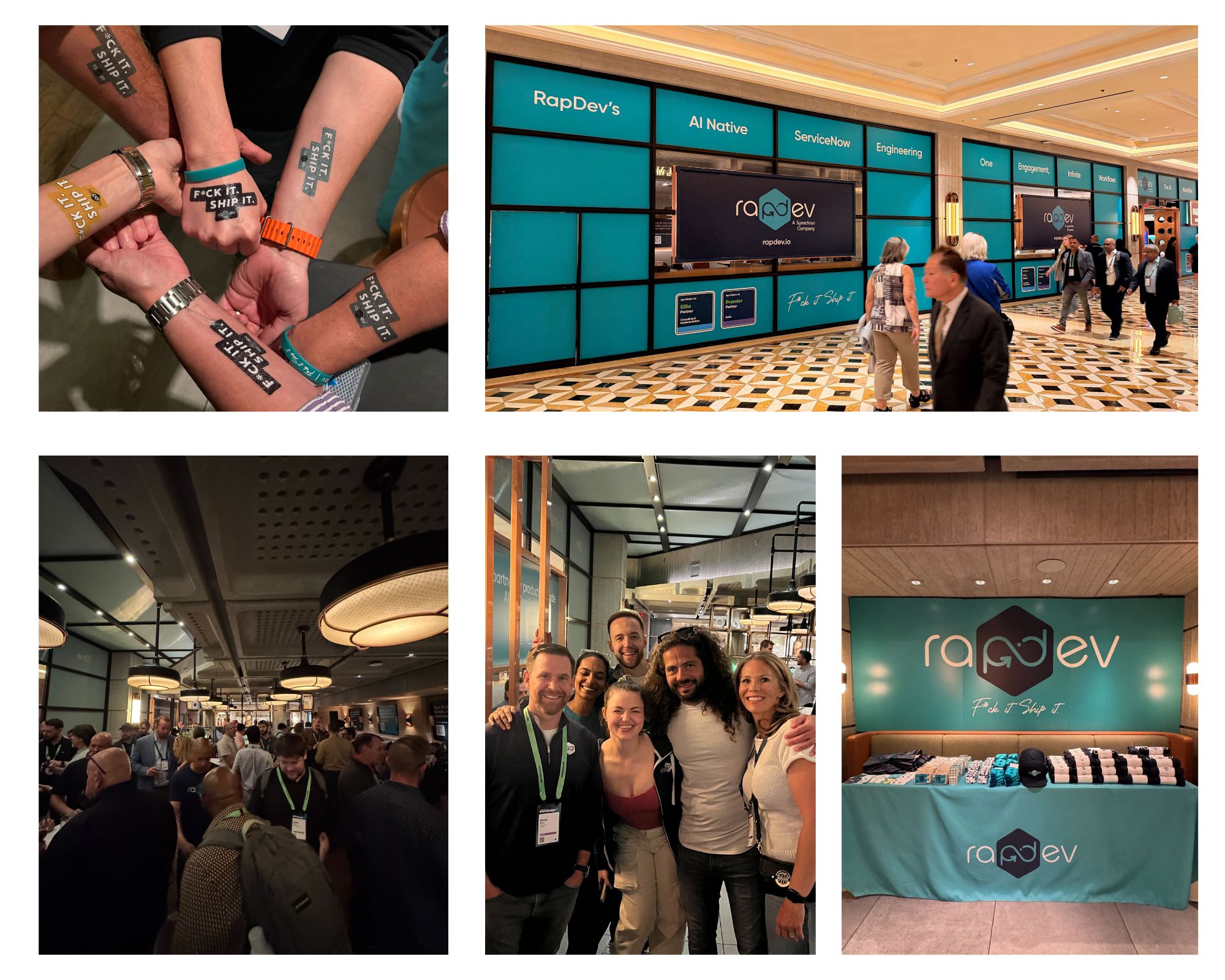
Knowledge isn't just a product conference - it's where the ServiceNow community actually reconnects, and this year's vibe reflected how much the ecosystem has matured around AI.
Our Happy Hour at Matteo's on Wednesday night was something else. The line stretched from Matteo's all the way to the casino floor - and we handed out 150 fireball nips in the first 15 minutes. 440 people came through. The conversations spilled well past the official end time, and the energy in that room was a good proxy for the overall momentum of the week.
We also heard a consistent theme from partners on the floor: a lot of teams are struggling, and they're looking for someone they trust. Multiple people - some from companies we know well, some we'd never met - came by specifically to say RapDev is the gold standard. That kind of feedback doesn't come from a press release. It comes from years of doing the work right.
Beers with Engineers brought another 100+ of the more technical crowd together for the kind of honest, shop-talk conversations that don't happen on the expo floor. Across everything - booth, happy hour, BwE, the hospitality suite, the meeting suite - we touched over 1,200 people this week.
Check out our recap video from Knowledge 2026.
If you were there and we didn't get a chance to connect - or if something from this post sparked a question - reach out to us. We're already thinking about what K27 looks like.