
Datadog implementation is only the beginning. Agents are deployed. Dashboards are built. Alerts fire. Logs flow. But scaling Datadog the right way requires more than telemetry. It requires structure.
Datadog Teams is often implemented during rollout. Teams are created. Users are grouped. A few services are mapped. If Teams are not treated as foundational infrastructure, ownership inside the platform drifts away from ownership inside the business.
Without structured alignment, visibility fragments. Costs become unclear. Incident reporting loses accountability. Executive reporting becomes manual.
Datadog Teams changes that. It transforms observability from a monitoring tool into an operating model designed to scale.
Growth Without Ownership Creates Blind Spots
After implementation, change is constant. New services launch. Applications scale. Logging expands. APM adoption grows. Metrics multiply.
Because Datadog is consumption-based, telemetry growth directly impacts spend. Without ownership embedded into the platform, small configuration changes can create large financial consequences before anyone notices.
When Teams are properly implemented using defined handles and consistent team:<handle> tagging, dashboards, monitors, services, incidents, and usage can all be filtered by ownership.
Cost stops being abstract. It becomes attributable. And attribution is what makes scale sustainable.
Aligning Spend to Business and Compliance Criticality
Not all applications deserve equal observability investment.
If a revenue-generating platform consumes the same budget as a low-impact internal tool, priorities are misaligned.
But business impact isn’t the only driver. Some systems demand deeper observability because of regulatory or legal obligations. Applications handling financial transactions, healthcare data, PII, or audit-sensitive workflows often require enhanced logging, retention, and traceability to meet SOC 2, HIPAA, PCI-DSS, GDPR, or internal governance requirements.
Higher-priority systems, whether revenue-critical or compliance-sensitive, typically require:
- Extended log retention for audit trails
- Broader trace coverage
- Lower sampling for forensic visibility
- Synthetic validation of uptime
- Enforced SLOs tied to contractual or regulatory SLAs
Lower-tier systems can operate lean.
With Teams and priority tagging in place, organizations can compare spend vs. business and compliance criticality, identify low-value overconsumption, justify higher telemetry investment for regulated workloads, and align observability depth with risk exposure.
Observability spend should reflect business value and regulatory obligation, not accidental ingestion.
Ownership Enables Measurable Maturity
Teams provide structural clarity.
Mature organizations can immediately answer:
- Who owns this service?
- Who is on call?
- What are its SLOs?
- What is it costing?
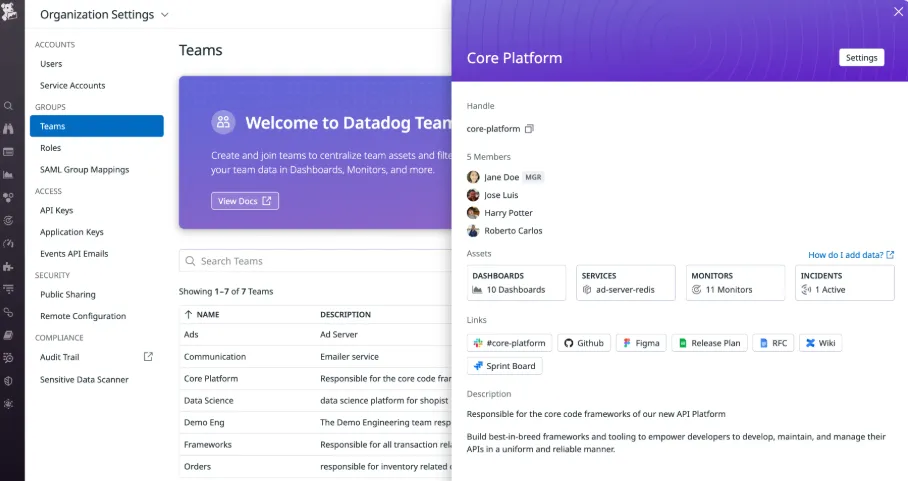
Without Teams, those answers live in tribal knowledge. With Teams, they live in the platform.
But ownership alone is not maturity. Standards are required.
Measuring Maturity with Datadog Scorecards
Datadog Scorecards introduce measurable service standards.
You can define rules such as required tags, configured SLOs, active monitors, on-call assignments, and linked runbooks.
Instead of asking, “Are we mature?”, you measure it.
Combined with Teams, Scorecards allow you to evaluate compliance by team, compare maturity across business units, identify monitoring gaps, and tie readiness directly to executive reporting.
Maturity becomes visible. And measurable maturity enables controlled scale.
Teams + Bits AI: Scaling Insight, Not Just Data
As environments grow, volume increases. Manual analysis does not scale.
This is where Datadog Bits AI becomes powerful, especially when paired with Teams.
Bits AI analyzes telemetry, incidents, and service relationships to surface insights, suggest root causes, and accelerate investigations. When Teams are properly mapped, AI-generated insights can be scoped to team-owned services, incident summaries align automatically to accountable groups, cost anomalies are contextualized by ownership, and suggested remediation reaches the correct team.
Without structured ownership, AI lacks context.
With Teams in place, Bits AI operates within an accountability framework, accelerating resolution while maintaining clarity.
AI speeds analysis. Teams ensure the right people act.
Together, they make scale manageable.
Executive Reporting That Reflects Organizational Reality
Executives care about risk, reliability, revenue exposure, and financial impact.
Teams allow telemetry, incidents, spend, and scorecard results to roll up by business domain.
An effective executive view includes:
- Reliability – SLO performance and error budgets
- Incidents – Severity trends and MTTR
- Financials – Spend by team and priority tier
- Maturity – Scorecard compliance distribution
Observability reporting shifts from system metrics to organizational performance. That shift is essential when Datadog becomes a strategic platform.
Incident Management Becomes Structured
With defined ownership, incidents map directly to accountable teams, alerts route correctly, MTTR becomes measurable by domain, and alert noise can be isolated.
Scorecards further expose whether missing monitors or SLOs contributed to incidents.
Patterns emerge. Improvements follow.
Ownership plus standards equals operational discipline.
A Foundation for Sustainable Observability
Datadog implementation unlocks visibility. Datadog Teams unlock accountability. Datadog Scorecards unlock measurable maturity. Datadog Bits AI unlocks intelligent acceleration.
When ownership, prioritization, standards, and AI-driven insight align:
- Spend reflects business value
- Regulated systems receive appropriate oversight
- Incident performance improves
- Executive reporting becomes meaningful
- Observability maturity becomes enforceable
Observability should not grow accidentally. It should scale intentionally with structure, automation, and intelligence built in from the foundation.
How RapDev Helps You Scale Datadog the Right Way
Implementing Teams and Scorecards is the foundation. Scaling them across a constantly evolving application and infrastructure landscape is where complexity emerges.
As services expand and architectures shift, without continuous oversight, ownership drifts, tags decay, scorecard compliance declines, spend misaligns, and executive clarity fades.
RapDev helps organizations design and operationalize Datadog Teams and Scorecards as a scalable governance model, not a one-time configuration.
We assist with designing team structures aligned to business value streams, implementing tagging governance and normalization, automating Team management via API and identity integrations, operationalizing Scorecards as enforceable standards, aligning Bits AI workflows to team ownership, building executive dashboards that tie spend, reliability, maturity, and risk together, and continuously auditing environments to prevent drift.
Your infrastructure will evolve. Your observability model must evolve with it.
RapDev acts as an extension of your team, ensuring your Datadog environment remains structured, optimized, and scalable as your business grows.
Implementation unlocks capability. Operational discipline sustains scale. Reach out to RapDev to learn more.

.svg)