.svg)

As organizations expand their engineering teams and services, their observability footprint naturally grows with them. Over time, this expansion often introduces inconsistencies—misaligned naming conventions, missing tags, unclear ownership, or dashboards and monitors that follow different patterns depending on who created them. These issues accumulate slowly, but eventually they make environments harder to navigate and maintain.
Whether you’re a seasoned Datadog professional or still learning the ropes, chances are high that you’ve run into at least one of these issues. Without a proper tagging strategy and a process to enforce it, resources can feel scattered, isolated and downright mysterious. This inevitably leads to longer MTTR (Mean-Time to Resolution) since troubleshooting becomes cumbersome and takes significantly longer than it should.
Datadog’s Resource Policies are designed to address this challenge by providing a structured way to enforce standards at the platform level. Instead of relying on documents, tribal knowledge, or after-the-fact cleanup, teams can define expectations once and let Datadog apply them consistently. It’s a shift from manual governance to automated, platform-embedded guardrails.
Why Resource Policies Matter for Modern Teams
Currently, Resource Policies apply specifically to infrastructure and cloud-level resources. This includes things like On-Premise and Cloud-hosted VMs, Kubernetes Clusters, and AWS/Azure/GCP-hosted resources like AWS Lambdas, Azure SQL Servers, etc. While the feature may expand over time, focusing on these core assets already brings powerful benefits to organizations struggling with drift or inconsistency in their ecosystem of VMs, containers, and cloud-based resources.
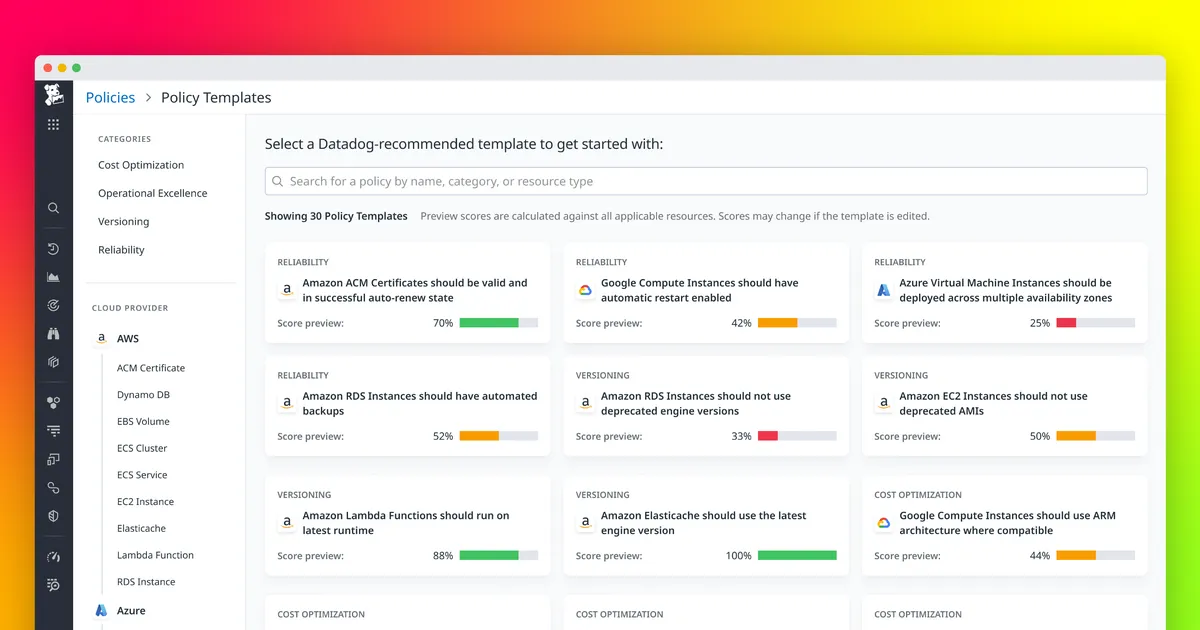
A Resource Policy can either be custom (requiring specific attribute values from your cloud resources) or based on tagging (requiring specific tag keys). Policies can specify naming patterns, require particular tags, or enforce the presence of ownership details. When someone creates or updates a resource, Datadog evaluates it against the policy and offers remediation guidance. On the Policies page in the Resource Catalog, Datadog also provides a compliance score based on the total percentage of each resource type meeting the filter criteria (ex, “All NodeJS-based Lambdas must use the latest runtime version.”) This keeps new assets aligned without forcing teams to memorize or interpret standards themselves.
For platform and SRE teams, this reduces a significant amount of manual oversight. Instead of reviewing resources individually or correcting issues after the fact, they can invest their time in refining standards, improving automation, and supporting teams more strategically. Policies shift the focus from cleanup to prevention - from Reactive to Proactive!
A Step Toward More Sustainable Governance
Even with their current scope limited to infrastructure-level assets, Resource Policies offer a notable improvement in how organizations manage their Datadog environments. By making expectations explicit and enforceable, they help teams maintain a consistent, navigable observability foundation—one that scales more gracefully as systems and teams grow.
For companies looking to reduce observability drift or formalize their operational standards, Resource Policies provide a practical, low-friction way to bring structure and consistency to a complex ecosystem. They’re an early but important step toward more sustainable observability governance.
Ready to Standardize Your Datadog Environment?
Resource Policies are a strong first step, but lasting impact comes from aligning them with a broader strategy around tagging, ownership, and governance. If you’re looking to reduce observability drift, improve consistency across your environment, or build a scalable governance model in Datadog, reach out to RapDev.