

Designing for Change
When ServiceNow implementations start growing up, one of the first architecture problems you encounter is this: How do you support different business behaviors without turning your core application into a maze of if/else statements?
That is exactly where Scripted Extension Points shine.
A Scripted Extension Point lets you define a standard interface for a behavior and then allows different implementations to plug into it. Instead of hard-coding every exception directly into your main logic, you create an extension point once and let specific use cases register their own handlers.
The result is an application that is more modular, easier to test, easier to maintain, and far easier to evolve over time.
Think of it as designing for change on purpose.
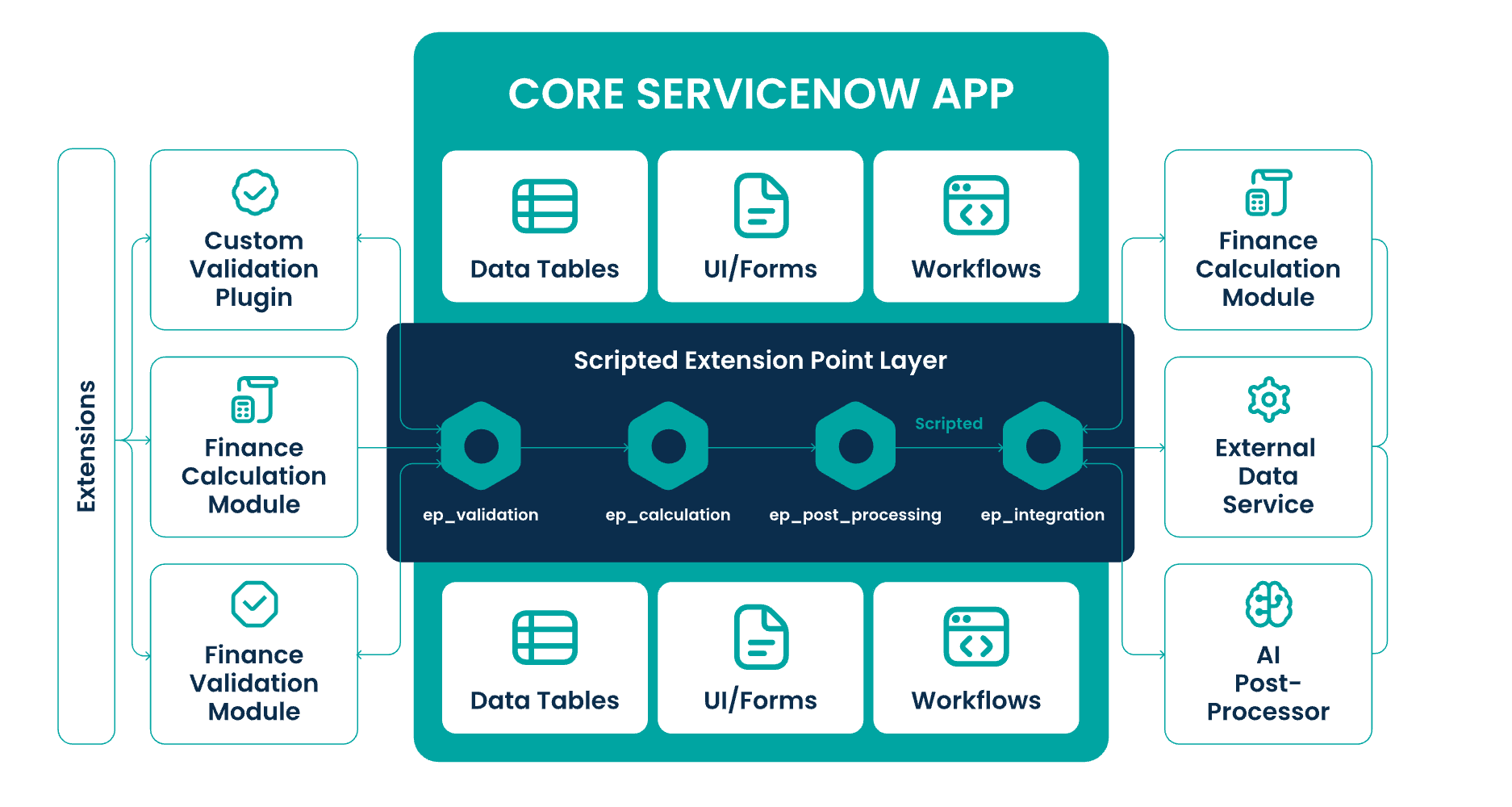
For example, imagine a fulfillment workflows that needs different assignment logic based on region, business unit, or product line. Without an extension point, that logic often ends up buried inside one large Script Include:
if (region === 'americas') {
// Americas assignment logic
} else if (region === 'emea')
{
// EMEA assignment logic
} else if (region === 'apac') {
// APAC assignment logic
}
Every new requirement makes the code a little harder to follow and a little riskier to change.
With a Scripted Extension Point, the core workflows only needs to retrieve the registered implementations and run the one that applies:
var extensions = new GlideScriptedExtensionPoint() .getExtensions('x_your_scope.FulfillmentAssignment'); for (var i = 0; i < extensions.length; i++) { if (extensions[i].appliesTo(current)) { current.setValue( 'assignment_group', extensions[i].getAssignmentGroup(current) ); break; } }Each extension implements the same methods, such as appliesTo() and getAssignmentGroup(), but contains logic for a specific region or business unit. When a new assignment model is needed, the development team adds another implementation instead of modifying the core workflows.
That small distinction has a significant architectural impact. The core application remains stable while its behavior can evolve independently.
This pattern supports a few things we care deeply about at RapDev: maintainability, scalability, and thoughtful engineering. Good ServiceNow solutions are not just built to work today; they are designed to absorb tomorrow’s requirements without forcing a rewrite.
Where Extension Points Pay Off
Scripted Extension Points help reduce technical debt by separating stable platform logic from variable business behavior. That separation makes enhancements less disruptive and gives each implementation a clear responsibility.
They are also valuable for team development. Multiple developers can work on separate implementations without repeatedly modifying the same core Script Include. Platform owners can preserve a clean application architecture while still enabling controlled customization - especially important in enterprise environments where requirements often grow faster than expected.
That said, Extension Points are not a magic wand. They work best when there is a genuine need for variation and a clearly defined contract. If the behavior is simple and unlikely to change, a more straightforward design may still be the better choice.
But when you know multiple pathways are coming, Scripted Extension Points are one of the smartest tools in the ServiceNow architect’s toolbox.
Use them when you want flexibility without chaos. That is the kind of architecture that scales - and the kind of engineering we like to build.
Build for What's Next
Scripted Extension Points keep your core logic stable while business behavior changes around it. Define the contract once, add an implementation for each new requirement, and leave the working code alone. That is architecture that scales.
Planning a ServiceNow build that needs to handle change? Talk to the RapDev team.