

From Reactive Firefighting to a Certified Foundation
Most IT operations teams spend the majority of their capacity on reactive, repetitive work: resolving the same incidents, fulfilling the same requests, manually validating system health, and running routine maintenance. This model has three structural limits. Resolution time is bound by human availability, so it directly caps service availability. Operating cost grows linearly with volume; more incidents mean more people. And your best engineers spend their days on low-value toil instead of the improvement work only they can do.
Autonomous Operations (AutOps) is the answer to all three: an operation that detects, diagnoses, and resolves known scenarios on its own, continuously certifies new ones, and frees human capacity for higher-value work. The hard part isn't the technology. It's the roadmap: knowing what to automate, in what order, with what guardrails, and how to prove it's working before you scale.
This is a practical guide to building that roadmap. The single most important idea to internalize first:
Autonomy is a curve, not a switch. No system goes from manual to fully autonomous overnight, and no responsible team wants it to. Every domain climbs the same maturity curve, and what determines the slope isn't the AI; it's the foundation you build underneath it.
To keep this practical, we’ve split the roadmap into two parts. This post covers Steps 0-4: deciding how you’ll measure success, mapping your sources of automation, baselining your operation, finding where incident time actually goes, and defining the certification model through which scenarios earn autonomy. Part 2 covers Steps 5-8: how each automated action executes, the guardrails and permanent exclusions that bound it, the change-enablement and ChatOps layer, and how to sequence the rollout domain by domain.
Step 0: Decide How You'll Measure Success
Before you automate anything, agree on how you'll know it's working. The trap here is inventing new "AI metrics" or vanity numbers that look impressive and mean nothing.
Don't. Measure AutOps with the same business and IT metrics that already govern your operation: availability, MTTR, throughput, productivity, and cost. If automation is working, your existing dashboards improve. If it isn't, they don't. This keeps the whole initiative honest and makes the value legible to people who control the budget.
Typical targets teams set as working hypotheses, to be validated against a real baseline, not committed to blindly:
- 40–60% of recurring, known-scenario incidents self-remediated without human intervention
- 25–50% reduction in MTTR for automatable incidents
- 30–50% of tickets and requests handled end-to-end without an analyst
- 30–60% first-contact deflection on AI chat support
- 10–30% of operational capacity freed for higher-value projects
Treat these as directional until your own data replaces them (see Step 2).
Step 1: Map Your Sources of Automation
Automation doesn't start from a tool. It starts from a trigger, the event that should kick off an automated action. There are five, and together they define the functional scope of an autonomous operation:
- Observability alerts. An alert from your monitoring platform identifies an incident, and the system automatically executes the remediation. The mature evolution of this is moving from reactive detection to predictive detection - catching problems before they impact service.
- User tickets. When a user reports a request or incident, the solution runs end-to-end without an analyst touching it.
- The daily operational checklist. The routine health validation your team does every morning runs automatically, escalating only deviations.
- Preventive maintenance. Stability routines are scheduled and executed without manual intervention.
- Automated chat support. Users get immediate help through a generative-AI assistant that understands natural language and resolves complete requests in the conversation, not a menu-driven bot.
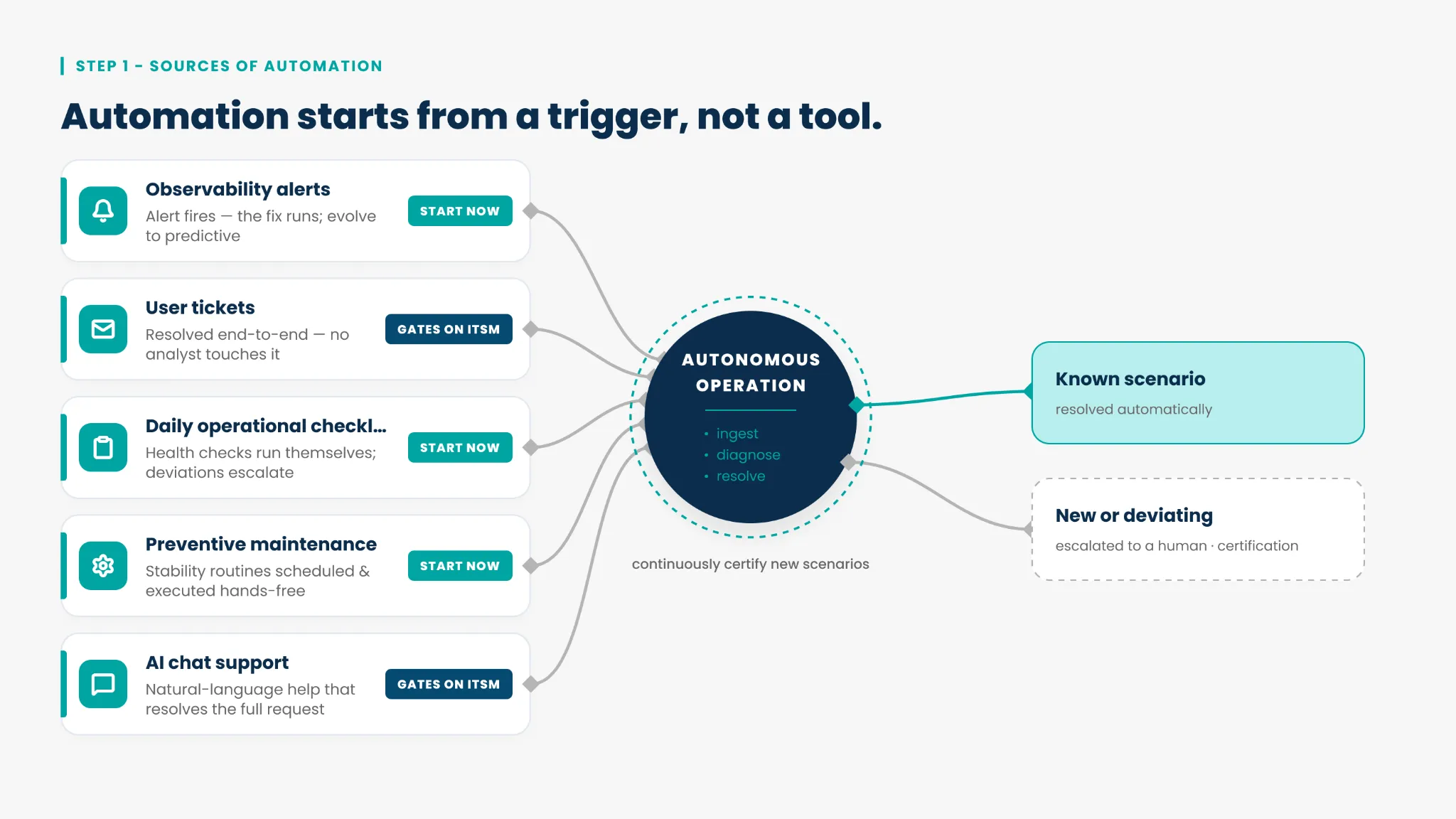
Inventory which of these you can light up immediately versus which depend on other systems. Anything driven by your observability and automation stack can usually start now. Sources tied to your ticketing platform (tickets, AI chat) gate on that platform being in production. Don't wait for the slow dependency to start on the fast ones.
Step 2: Baseline Before You Build
This is the step teams skip, and it's the one that determines whether your roadmap is fundable. Your targets stay directional guesses until you measure reality. Gather this data first; it's how you turn ambitions into a phase-by-phase business case:
To Size The Prize (volume and repeatability):
- Incident volume by priority and by domain
- Top recurring incident types: this is the single most important number, because it's the share of your volume that's actually automatable
- Ticket volume and the percentage plausibly auto-resolvable
To Size The Value (time and cost):
- MTTR by priority, broken into phases (more on this in Step 3)
- Cost per hour of downtime for your highest-priority incidents
- Engineer-hours spent on reactive work, at fully-loaded cost
To De-Risk the Climb (change and adoption):
- Change volume and the rate of change-induced incidents
- On-call and after-hours incident load
- The capacity you can realistically redeploy as work gets automated
With this baseline, abstract targets become a funded plan. Without it, you're asking for budget on faith.
Step 3: Decompose a Real Incident, Find Where the Time Actually Goes
Pull one representative high-priority incident and break its MTTR into phases:
- Detect - time until something flags the problem
- Acknowledge and assemble - time to get the right humans engaged
- Diagnose - time to find root cause
- Remediate - time to apply the fix
- Verify and close - time to confirm recovery, close out, and capture learnings
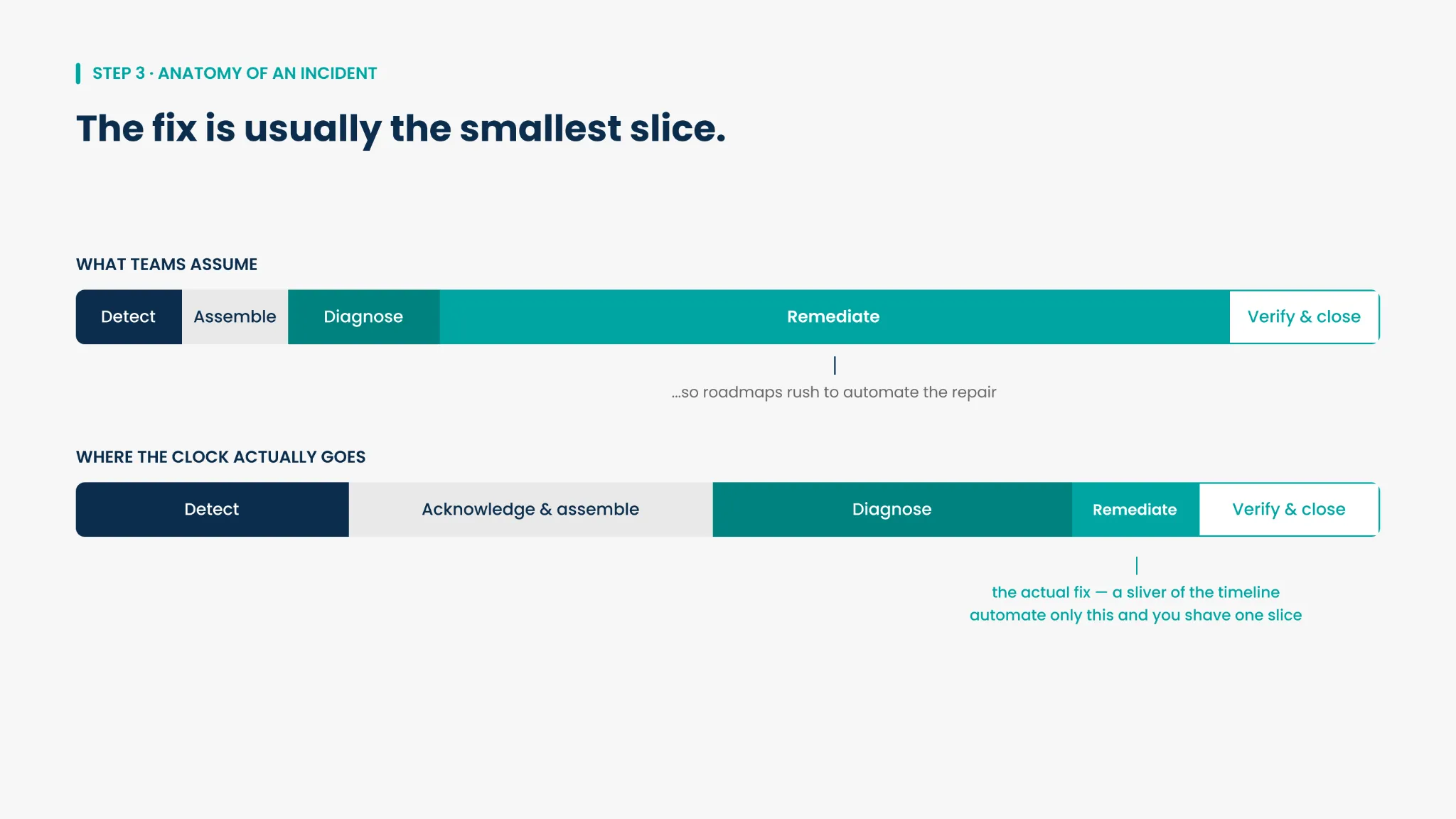
Here's the insight that reshapes most roadmaps: the fix is usually the smallest slice. Teams assume MTTR is dominated by repair, so they rush to automate remediation. But in practice, detection, human coordination, and diagnosis consume the bulk of the timeline. Automate only the fix, and you shave one slice. Attack detection, coordination, and diagnosis, and the whole timeline collapses.
Map each phase to a capability: detection and diagnosis to your observability and AIOps layer, coordination to ChatOps and incident management, remediation to your automation engine. Now your investment targets are where the time actually is.
Step 4: Define the Autonomy Model and a Certification Cycle
The guiding principle of safe automation: full autonomy for known scenarios, human validation for new ones. No scenario earns autonomy without first demonstrating reliability. Make that operational with a three-stage certification cycle every scenario passes through:
- Assisted (new scenario). Automation detects the issue and proposes an action; a human validates and executes. The scenario gets documented.
- Supervised (under observation). The action runs automatically but under active watch, until it clears a threshold, say, 10 to 20 consecutive successful executions with zero failures.
- Autonomous (certified). The scenario runs fully automatically, with ongoing auditing of its success rate. If a certified scenario ever fails, it reverts to supervised.
Govern this with a small, fast certification body; a weekly 30-minute review is plenty, that promotes scenarios that clear the bar, sends back the ones that don't, and maintains the official catalog of what's certified. Keep it lean; heavyweight governance kills momentum.
Where Part 1 Leaves You
Work through Steps 0-4 and you have the strategic half of the roadmap: success defined in metrics your business already trusts, the five triggers that scope your autonomous operation, a baseline that turns directional targets into a fundable business case, an incident timeline that shows where investment should actually go, and a certification cycle that makes autonomy something a scenario earns, never something it’s granted by default.
In Part 2, we put that foundation to work: deciding how each automated action executes, setting the guardrails and permanent exclusions that keep autonomy safe, building the change-enablement and ChatOps layer that makes every automated fix auditable, and sequencing the rollout domain by domain - plus the single organizing picture that ties the whole roadmap together.
Looking for more support? Reach out to our team.


.png)