.svg)

The Repetitive-Work Tax
Every mature ServiceNow platform pays it. One recent RFP came in with 10,000+ business rules, 10,000+ script includes, and 400+ incidents a month. Most of that work is structured, repetitive, and reversible exactly the work offshore teams were hired to absorb, and exactly where quality slips and turnaround stretches. APO, our Agentic Platform Operator, absorbs that load differently.
Zoom into a real instance and the "repetitive-work tax" gets concrete fast. A platform that size typically runs 15+ MID Servers, a dozen-plus IntegrationHub spokes, and close to 100 scheduled import jobs, and every family upgrade generates hundreds of skipped updates that someone has to triage before the next release. None of that is hard work. It's just a lot of it, and it's exactly the layer APO is built to absorb.
A Managed Service, Not Software You Pilot
APO isn't a product you buy a seat for and evaluate. It's a managed service. The shift is from offshore human support to onshore human support, augmented with AI agents. The agents are co-pilots, people still deliver the work, own the outcome, and talk to your team. You aren't testing a tool and hoping it holds up in production. You're engaging a team that works faster because agents handle the rote parts.
In practice, that means your day-to-day contact is always a named engineer for incident response, CAB representation, and escalations. APO runs behind that engineer, continuously sweeping the platform: watching for incidents, picking up capability-development requests (catalog items, workflows, business rules, UI policies, Flow Designer, IntegrationHub spokes), and running proactive maintenance (metadata scans, CMDB hygiene, Discovery/Service Mapping health checks) in the background.
Governance Is the Product
The real product is how APO decides what an agent may touch. Every change gets classified and routed through a three-tier scope contract:
- Auto-approve for low-risk, reversible changes
- Change request routed through your existing CAB for anything that needs review
- Explicit approval for novel or high-risk work
The invariant underneath all of it: production never auto-executes. APO's intelligence is in classifying risk and routing correctly, not in bypassing your controls. It feeds your existing ITIL and CAB workflows and learns your risk taxonomy from ~30 days of passive observation. No new process to adopt.
What each tier looks like day to day:
- Auto-approve: A catalog form has a mislabeled field that's been generating confused submissions for months. APO catches it, corrects the label, and logs the change; no ticket needed, because the change type was pre-authorized as low-risk and reversible during onboarding. The same tier covers UI policy tweaks and other cosmetic, one-click-to-undo fixes.
- Change Request: A business rule needs a logic change that affects a downstream workflow. APO doesn't just flag it; it drafts the CR, including the impact analysis, and routes it through your CAB exactly the way a human engineer would. Once it's approved, an engineer promotes it. APO did the prep work; a person still made the call and pushed the button.
- Explicit approval: Something novel or high-risk comes up a change with no precedent in the risk taxonomy, or one that touches a system with elevated blast radius. APO stops and pings a named approver directly rather than guessing. No default-to-yes.
The loop underneath
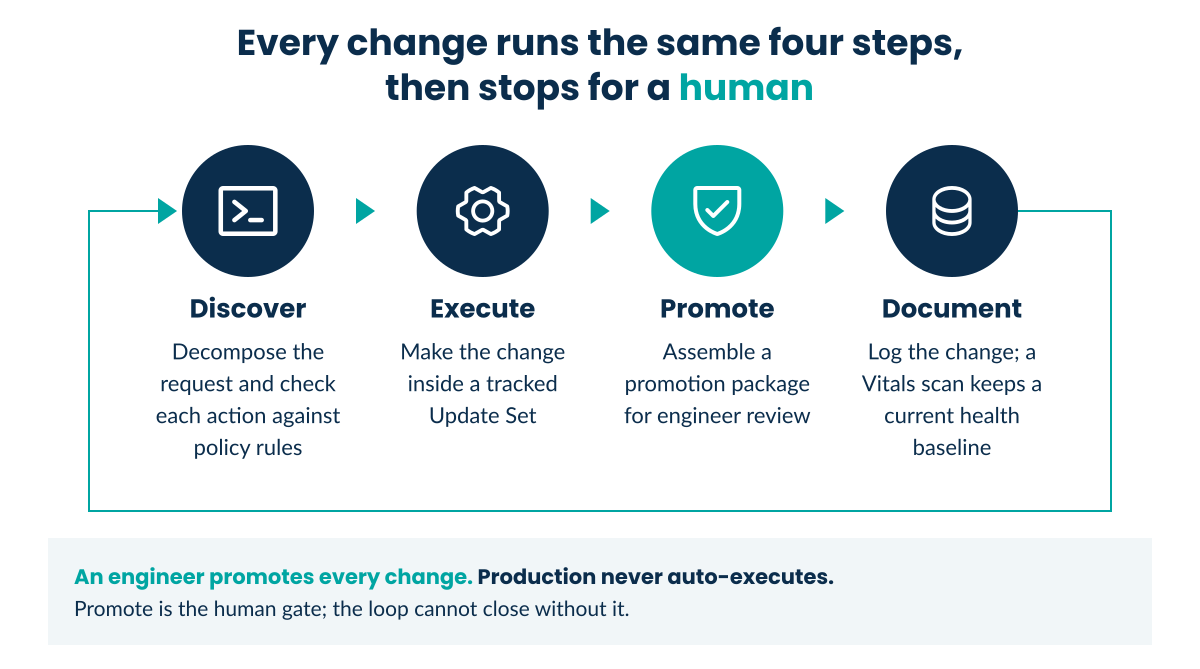
Mechanically, every action follows the same pattern: discover → execute → promote → document. Agents decompose a request, check each proposed action against policy rules, make changes inside a tracked Update Set, and assemble a promotion package for engineer review before anything reaches production. A built-in Vitals scan runs at onboarding and on a regular cadence afterward, so you always have a current health baseline of the instance, not just a snapshot from the kickoff call.
What "AI in the Loop" Looks Like on an Incident
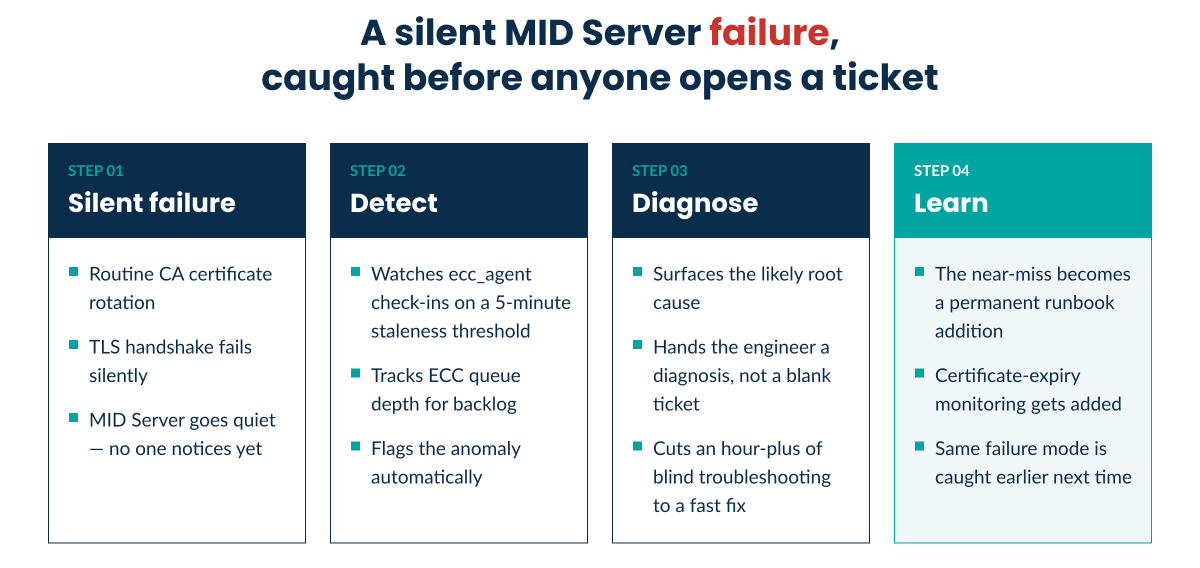
Platform Incident Response is where the agent-plus-engineer model earns its keep. Picture a MID Server going quiet after a routine CA certificate rotation - a silent TLS handshake failure that nobody notices until the ECC queue has backed up by the thousands. APO watches ecc_agent check-ins against a 5-minute staleness threshold and the ECC queue depth for exactly this kind of backlog. It flags the anomaly, surfaces the likely cause, and hands the engineer a diagnosis instead of a blank incident ticket, cutting what would be an hour-plus of blind troubleshooting down to a fast, informed fix. That kind of near-miss also becomes a permanent runbook addition (in this case, certificate-expiry monitoring), so the same failure mode gets caught earlier the next time.
Built for Environments That Can't Take Chances
For regulated platforms, governance has to be provable, not just claimed. Each customer gets a dedicated namespace, scoped secrets, and a per-tenant kill switch that halts all in-flight and queued agent work in under a minute if something looks wrong. Agent actions run inside the named engineer's authenticated session, not a separate, anonymous service account, so everything shows up in your audit log attributed to a real person. And before anything reaches the underlying model, sensitive identifiers (emails, tokens, credentials, internal IDs) are stripped out; the model never sees them.
Why This, Why Now
AI is finally good enough to handle the rote layer, and cost pressure on offshore support keeps climbing. Onshore delivery with agents in the loop answers both without asking you to trust a black box with production.
Want to see how APO maps to your platform? Talk to our team.

.svg)