

What Is DevOps?
DevOps is a collaborative approach that unites software development (Dev) and IT operations (Ops) to deliver applications and services faster, more reliably, and with continuous improvement. It emphasizes automation, continuous integration and delivery (CI/CD), shared responsibility, and rapid feedback loops across the entire software lifecycle - from planning and coding to testing, deployment, and monitoring.
A typical DevOps pipeline is a streamlined, automated workflow that takes code from development all the way to production. It usually starts when developers commit code to a shared repository, triggering automated build and test processes that ensure the code is functional and secure. Once validated, the pipeline moves through pre-production environments for further testing and review before being deployed into live production systems. Throughout each stage, the pipeline relies on continuous integration and continuous delivery (CI/CD) tools - like Jenkins, GitLab, or Azure DevOps - to automate repetitive tasks, enforce quality checks, and provide immediate feedback. This automation helps teams release updates quickly, consistently, and with minimal human intervention.
How Can ServiceNow Improve the DevOps Process?
High change velocity is often a sign of mature DevOps practices such as continuous integration, automated testing, and streamlined deployments. However, without visibility and governance, rapid change can also introduce operational risk. ServiceNow DevOps Change Velocity centralizes all of your DevOps data and approvals within a single platform, leveraging the platform's capabilities to improve governance and gain insights, without slowing down development teams.
.webp)
.webp)
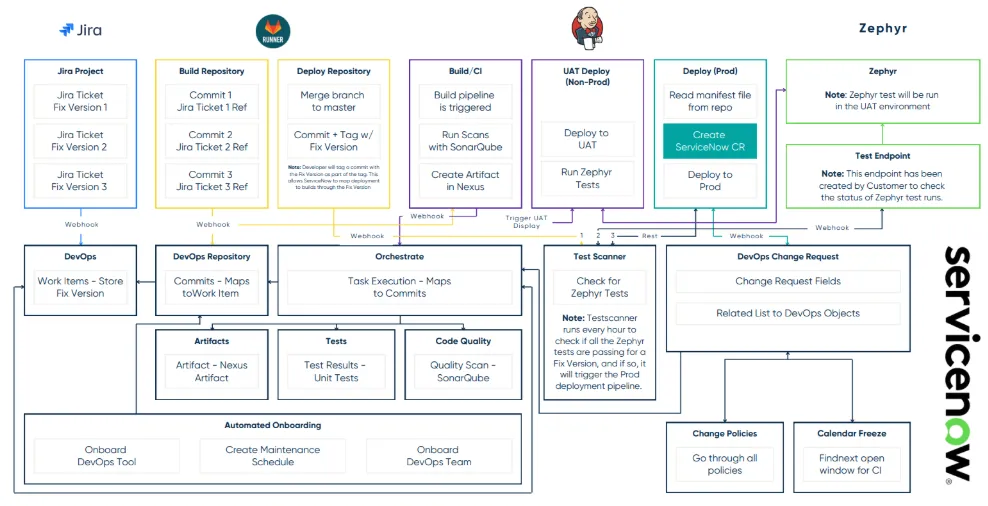
ServiceNow’s DevOps Change Velocity integration connects with popular tools including GitHub, GitLab, Azure DevOps, Jenkins, Jira, and others to track work items (user stories, issues, etc.), code commits, pipeline executions, automated test results, code quality checks, and more.
All of this DevOps data is associated with a change request generated in ServiceNow by the orchestration pipeline, typically before deployment steps begin. The change request acts as a policy gate in the pipeline, conditionally requiring manual approval based on predefined rules in a Change Approval Policy. These approval policies can factor in things like commit history, automated test results, code quality reports, and ServiceNow data, such as blackout or maintenance windows, or recent incidents related to the affected service. This ensures that only safe, compliant changes move forward, without slowing down innovation.
What Is the Role of DevOps Change Velocity in AIOps?
ServiceNow AIOps leverages data-driven intelligence to predict, prevent, and resolve issues before they impact users. It draws from Event Management, which connects to an organization’s monitoring tools such as SolarWinds, Splunk, Dynatrace, AppDynamics, and many others, to detect and correlate infrastructure and application anomalies.
When AIOps correlates alerts from these events with recent change request data, it can identify whether new code releases or configuration changes are a probable root cause (PRC) of an alert.
By integrating DevOps change data with AIOps insights, ServiceNow enables IT teams to:
- Correlate alerts and incidents to recent deployments instantly, accelerating root cause identification and reducing MTTR
- Predict change risk before deployment, using historical incident and failure patterns, and use that data as inputs to change approval policies
- Reduce false positives and event noise by factoring in active changes and known release windows
- Continuously improve release quality by learning which deployment patterns cause instability
Bringing It All Together
In a well-integrated ServiceNow environment, DevOps Change Velocity is more than a performance metric it becomes a proactive signal. When combined with AIOps’ anomaly detection and predictive capabilities, it transforms how teams respond to operational events. The result is a smarter, faster, and more resilient IT organization that can innovate confidently without compromising stability.
Ready to bring DevOps Change Velocity and AIOps together in your ServiceNow environment? RapDev's ServiceNow engineers have deep expertise in DevOps, ITOM, and AIOps implementations. Get in touch with our team to learn how we can help your organization release faster and respond smarter.