

Why Your CMDB Still Fails After a “Successful” Implementation
I’ve sat through the go-live parties. The dashboard shows 92% CI population. Discovery is running. Someone from the PMO hands out mugs. Everyone claps. Six months later, no one is smiling. Incident teams are manually verifying server ownership. The CAB has stopped trusting dependency maps. Application owners are back to spreadsheets because “the CMDB doesn’t reflect reality.” The CMDB is live. It’s just not trusted.
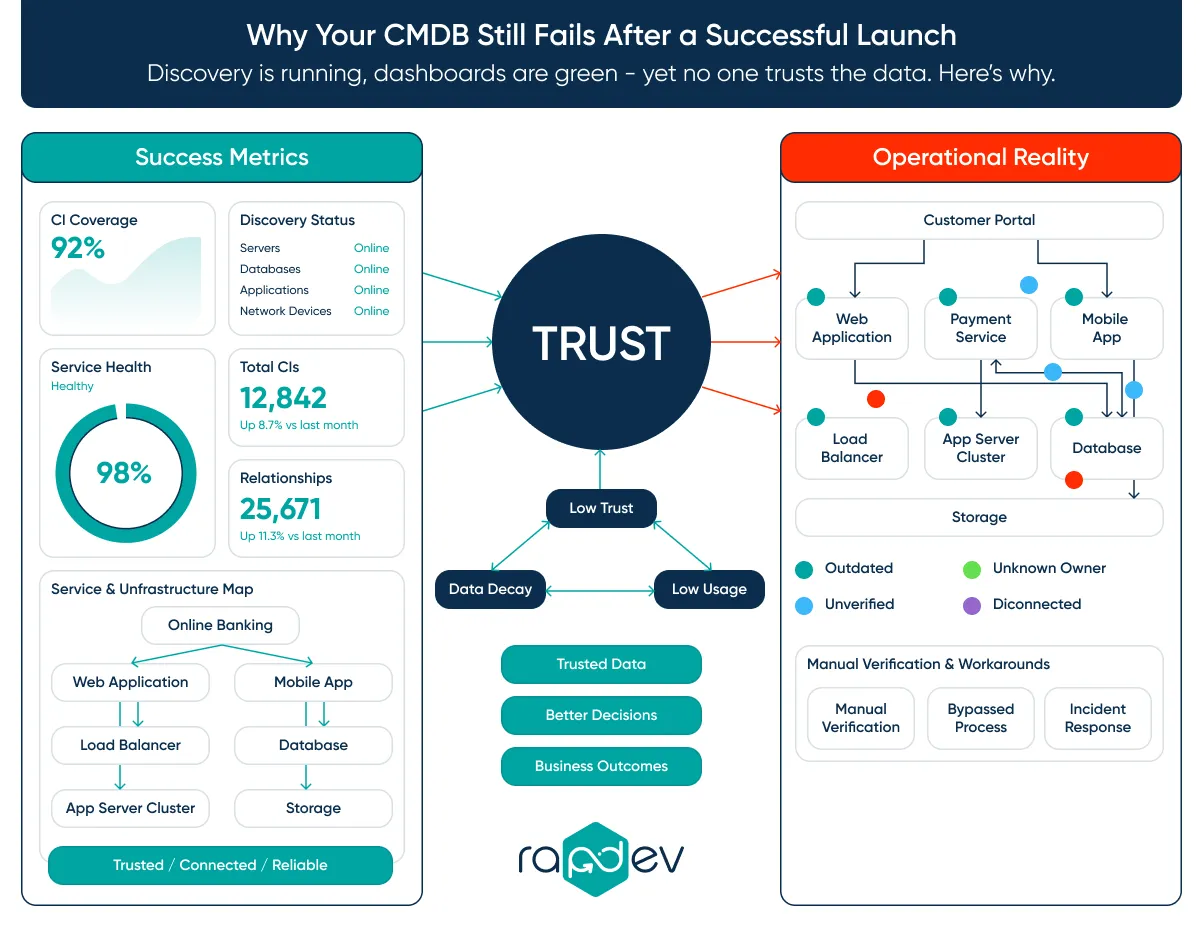
The Real Problem: Trust Decay
A CMDB doesn’t fail because it lacks data. It fails because it loses trust. And once trust starts slipping, a predictable cycle kicks in:
Low trust → Low usage → Data decay → Even lower trust
Most implementations never break this loop because the operating model that would sustain trust was never built in the first place.
The 5 Failure Modes That Feed the Cycle
- No real ownership. The project team dissolves at go-live, leaving platform admins with no authority over the business units that own the data. CIs age out silently.
- A model that doesn’t reflect reality. CSDM is a reference model, not a plug-and-play blueprint. Treat it as gospel, and you end up with elegant but irrelevant structures no one actually uses.
- Discovery as the only strategy. Discovery tells you what exists, not who owns it, whether it still matters, or how it supports a service. Infrastructure-heavy. Context-poor.
- Governance on paper only. The data governance section gets written into the project charter. Within three months, the meetings stop. CI accuracy drops from 85% at go-live to 40% within a year.
- Nothing depends on it. If incident, change, and problem processes can route around the CMDB, they will. Accuracy becomes optional. Optional data does not stay accurate.
What a CMDB That Actually Works Looks Like
The fix isn’t more data. It’s a different operating model.
- Explicit ownership: Named data owners per domain (apps, infra, cloud, network) with CMDB quality tied to their objectives. The platform team owns standards, not every record.
- Pragmatic modeling: Start with services that drive revenue or risk, then work backward. Use CSDM as a guide, not a cage.
- Multi-source data strategy: Discovery for infrastructure volume, targeted integrations (HR, asset management, cloud consoles) for authoritative attributes, human enrichment for context.
- Embedded governance: A small set of KPIs: completeness, relationship accuracy, attribute freshness reviewed monthly with data owners. Tied to real incidents where bad data caused delay.
- Real downstream dependency: When teams need the CMDB to resolve incidents, assess change impact, and understand service topology, data quality stops being optional.
The Only Metric That Matters
A CMDB is not successful because it is complete. It’s successful because it is trusted. If teams rely on it during an outage, it’s working. If they work around it, it isn’t.
A CMDB is not a project deliverable. It’s an operational capability, and most failures are the result of an operating model that never made trust sustainable. Fix the model, and the technology finally delivers on the promise everyone assumed was automatic.
Want to assess where your CMDB operating model stands? Reach out to us, we’d love to help.



.png)