
Anyone who has operated a modern distributed system knows one uncomfortable truth: things break in ways you never expect. A tiny latency spike in one service suddenly cascades across an entire application. A seemingly harmless deployment reveals a dependency no one realized existed. And sometimes, production just behaves differently than every staging environment, no matter how much you try to mirror it.
These challenges are exactly what led to the birth of Chaos Engineering, a practice that emerged in the early days of Netflix’s move to the cloud. As Netflix shifted to a highly distributed, microservices-based architecture, they discovered that traditional testing couldn’t keep pace with how complex systems failed in unpredictable ways. To address this, they created Chaos Monkey, a tool that randomly shut down production instances to ensure their systems were resilient by design. The idea was simple but transformative: if failures are inevitable, teams should expose them deliberately under controlled conditions so systems and engineers learn to withstand them before they cause real outages.
Chaos Engineering in practice typically begins with small, low-risk experiments: injecting latency into a single service, restarting a container, or simulating a dependency slowdown. These controlled tests help teams understand how their systems degrade and recover without introducing unnecessary risk. As confidence grows, experiments can expand to more complex scenarios.
A number of third-party and open-source tools support this type of experimentation:
- Gremlin: A polished platform with built-in safety controls and a wide set of failure types
- Chaos Mesh: Kubernetes-native and ideal for experimenting directly within clusters
- LitmusChaos: Open-source, workflow-driven, and friendly to CI/CD integration
- AWS Fault Injection Simulator: Purpose-built for testing AWS infrastructure behaviors
Why Organizations Invest in Chaos Engineering
The benefits of Chaos Engineering become more apparent as systems scale. Experiments expose hidden weaknesses such as misconfigured failovers, missing alerts, or resource bottlenecks that only surface under very specific conditions. Finding these issues proactively reduces the likelihood of major outages and improves recovery when incidents do happen.
Chaos Engineering also helps teams grow more confident in their ability to troubleshoot complex failures. By regularly observing how systems behave under stress, engineers strengthen their on-call readiness and build shared understanding across teams. Many organizations discover that chaos experiments naturally lead to better observability and more reliable alerting.
Strengthening Chaos Experiments With Datadog
As a trailblazer in the Observability Platform space, Datadog plays a pivotal role in Chaos Engineering by serving as the measurement and validation layer for every experiment. When teams introduce failures, whether it’s increased latency, a node termination, or a network partition, Datadog provides the real-time telemetry needed to understand how those disruptions propagate across services. Metrics highlight performance changes, traces reveal bottlenecks or unexpected dependency paths, and logs provide the granular context behind internal service behavior. Datadog’s service maps, notebooks, and dashboards make it easy to visualize system behavior before, during, and after an experiment, ensuring teams can confirm whether resilience mechanisms functioned as expected. Alerting behavior also becomes part of the evaluation: teams can assess whether monitors trigger at the right time, with the right severity, and with actionable context. In this way, Datadog doesn’t just support chaos experiments; it turns them into meaningful, measurable learning opportunities.
Building on that foundation, Datadog’s Chaos Controller lets teams move beyond observation and directly orchestrate failures in Kubernetes environments. By defining Disruption resources, engineers can specify the exact conditions they want to simulate, such as killing pods, stressing nodes, or injecting latency, without needing custom scripts or deep knowledge of the cluster’s internals. The controller executes these experiments in a controlled, declarative manner, making chaos tests easier to run, repeat, and analyze alongside the observability data already captured in Datadog.
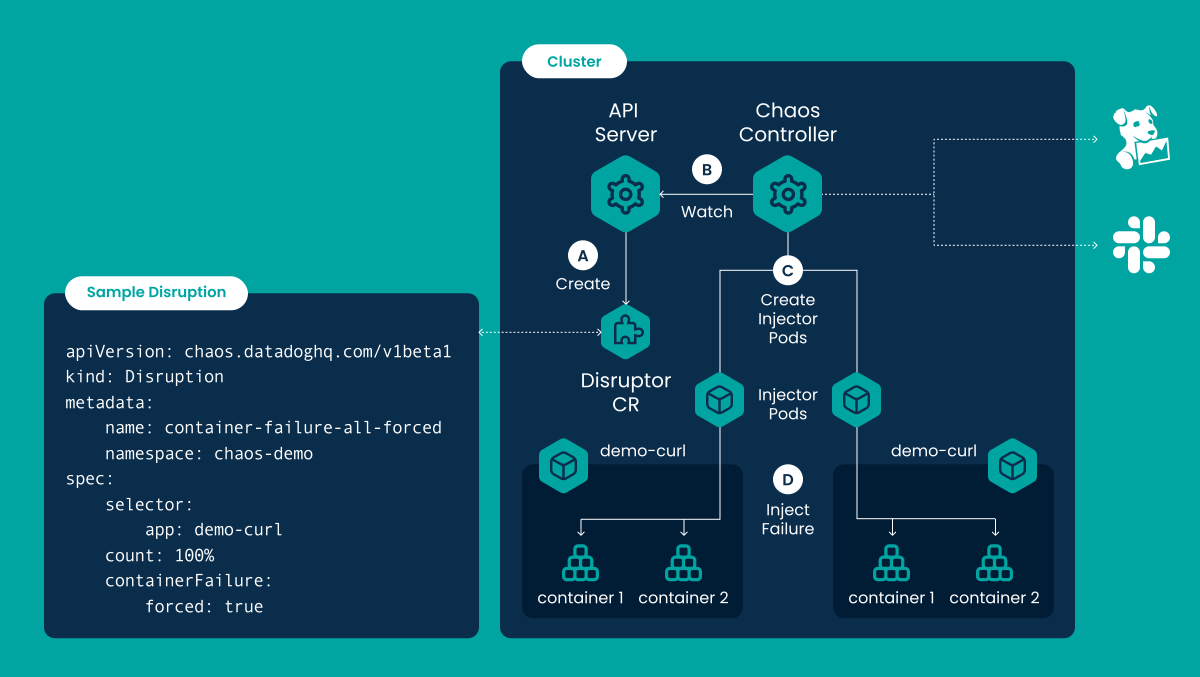
Afterward, Datadog makes it easy to assess results, compare pre- and post-experiment behavior, and refine runbooks or monitors based on what the experiment revealed. In our experience, many teams even maintain dedicated chaos dashboards, making future experiments smoother and more repeatable.
A Clearer Path to Reliability
Chaos Engineering helps teams move from reacting to failures to proactively understanding them. Combined with Datadog’s observability capabilities, it becomes a powerful method for uncovering weaknesses, validating resilience, and improving operational confidence. Together, they create a practical path toward stronger, resilient, and more predictable systems.
Ready to start testing your systems with Chaos Engineering and Datadog? Reach out to us.