
Most teams enabling Datadog Cloud Security Posture Management (CSPM) for the first time expect a clean dashboard and a clear path to compliance. What they get instead is 400 open findings across CIS, PCI-DSS, and SOC 2, spanning dozens of AWS accounts, half of which belong to environments nobody fully owns anymore.
The findings are real. But without a strategy for prioritization, scoping, and remediation ownership, CSPM becomes a compliance theater tool rather than a risk reduction one.
At RapDev, we've stood up Datadog CSPM for clients managing anywhere from a handful of cloud accounts to complex environments spanning multiple organizations with multi-cloud deployments.
Scope Before You Scan
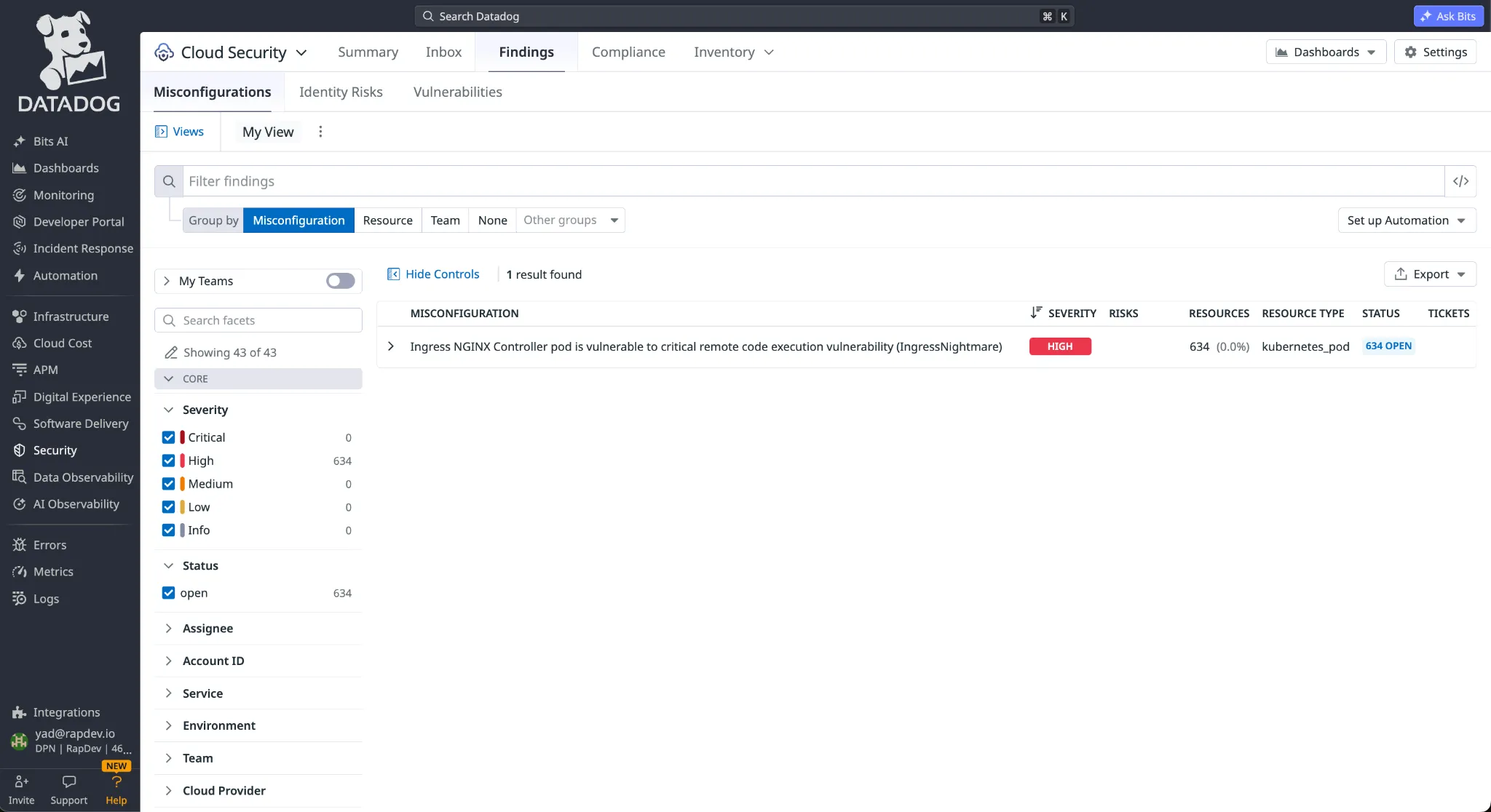
CSPM finds what you point it at. In environments with poor tagging discipline, that means findings surface across dev, staging, and production without distinction and your team spends time remediating a misconfigured S3 bucket in a sandbox nobody uses.
Before enabling CSPM broadly, define your scope using resource tags. Tag resources by environment (prod, staging, dev), by team or application owner, and by compliance relevance (SOC 2 in-scope, PCI cardholder data environment, etc.). Datadog CSPM uses these tags to filter findings and assign ownership. Without them, every finding lands in a shared queue that nobody acts on.
A client can have all of their tags correct at the cloud level, but critical production applications can be completely untagged, making it impossible to separate high-risk findings from low-risk noise without manual review of every result.
Pick a Framework and Finish It Before Starting Another
Datadog CSPM maps findings to CIS benchmarks, PCI-DSS, SOC 2, HIPAA, ISO 27001, and more. The instinct is to enable all of them. Don't! Each framework generates its own set of findings, and many overlap in ways that create duplicate work without adding real coverage.
Pick the framework most relevant to your current compliance obligations, SOC 2 if you're chasing an audit, CIS AWS Foundations if you want a solid baseline and work through it systematically. Once you've closed the critical and high findings in one framework, the others become substantially easier because the underlying infrastructure hygiene carries over.
Separate Signal Severity from Remediation Priority
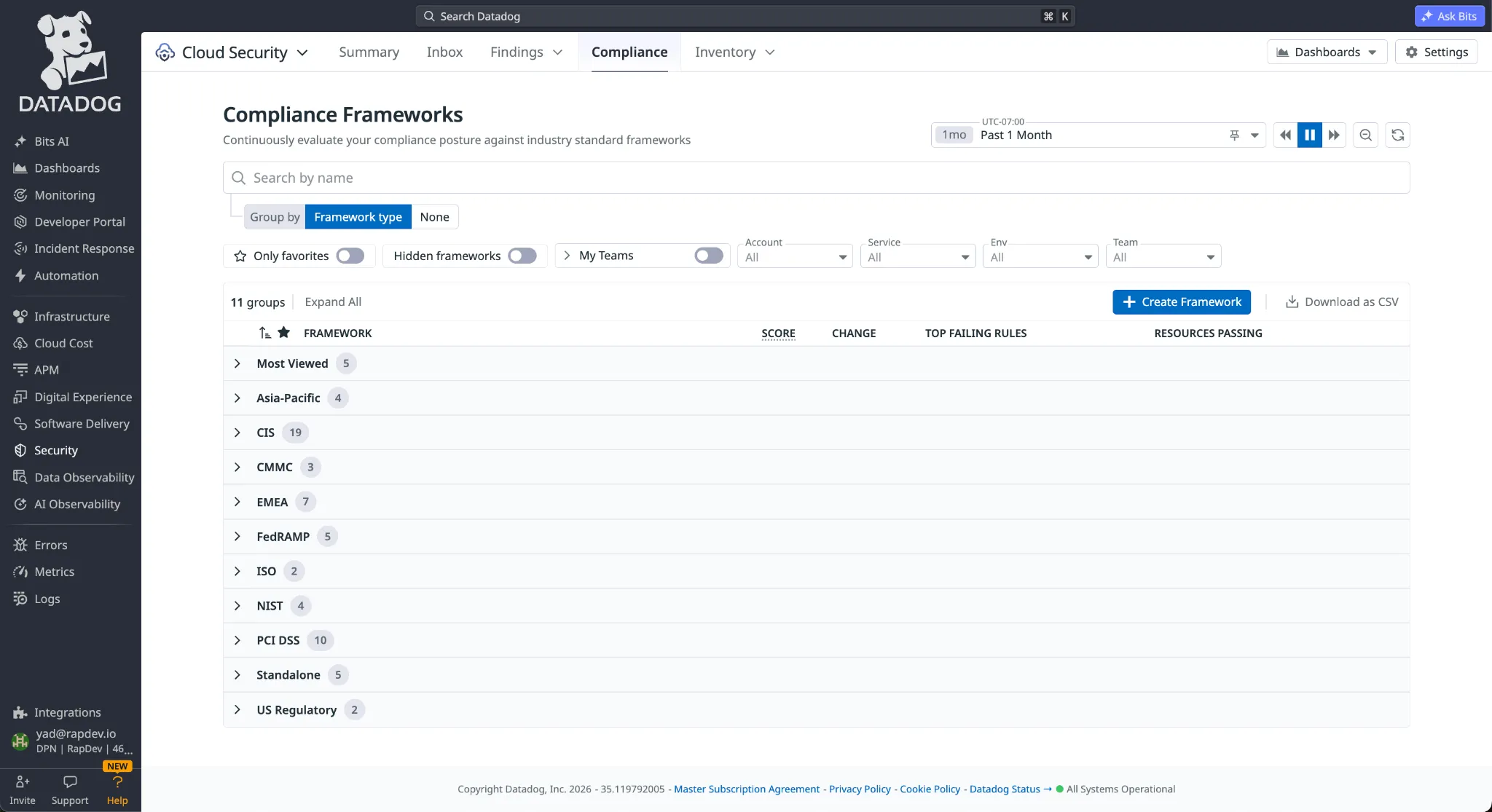
Datadog CSPM assigns severity (critical, high, medium, low) based on misconfiguration type. That's a starting point, not a remediation queue. A critical finding on an internet-exposed S3 bucket in production carries far more risk than the same finding in a dev environment with no sensitive data.
Layer your own context on top of severity: Is the resource in production? Does it store or process sensitive data? Is it reachable from the internet? That contextual triage determines what gets fixed this sprint versus what goes on a backlog.
Assign Findings to Owners, Not to Security
A big CSPM failure we see is findings that live permanently in a security team's queue because the teams who own the infrastructure don't have visibility into their own posture. Datadog CSPM supports assigning findings to teams and routing them through your ticketing system, use it!
When remediation ownership sits with the team that deployed the resource, fix rates improve and recurrence drops. Security's role shifts from fixing misconfigs to setting policy, reviewing coverage, and verifying remediation. That's the right division of labor.
Track Posture Over Time, Not Just Open Findings
A point-in-time count of open findings is a poor measure of progress. Environments grow, new resources get deployed, and new rules get added, all of which generate new findings independent of whether your team is remediating anything.
The metric that matters is posture score trend over time: are you improving, holding steady, or drifting? Datadog's compliance dashboards surface this, but you need a consistent baseline to compare against. Set one at implementation, track it weekly, and tie it to your compliance reporting cadence.
Implementing CSPM well is less about the tool and more about the operational habits around it tagging, ownership, prioritization, and consistent review. RapDev's managed SOC helps clients build those habits from day one, operating directly in your Datadog environment with no proprietary tooling and no lock-in. Reach out to RapDev to talk about your CSPM setup.